
Why feature requests need an escalation ladder
Most product teams treat feature requests as a backlog input. In practice, a request is also a signal about urgency, revenue risk, support friction, and customer fit. Without a consistent way to route requests, teams fall into two predictable failure modes: everything becomes “product’s problem,” or nothing gets acted on because there’s no clear owner.
A feedback escalation ladder is a lightweight decision system that answers two questions fast:
- Is this a product decision, a support decision, or a sales decision?
- What is the next best action right now?
The goal is not to ship more features. The goal is to convert raw requests into the right outcome: clarification, workaround, upsell to an existing tier, commitment on roadmap, or a documented “not planned” with rationale.
The ladder overview
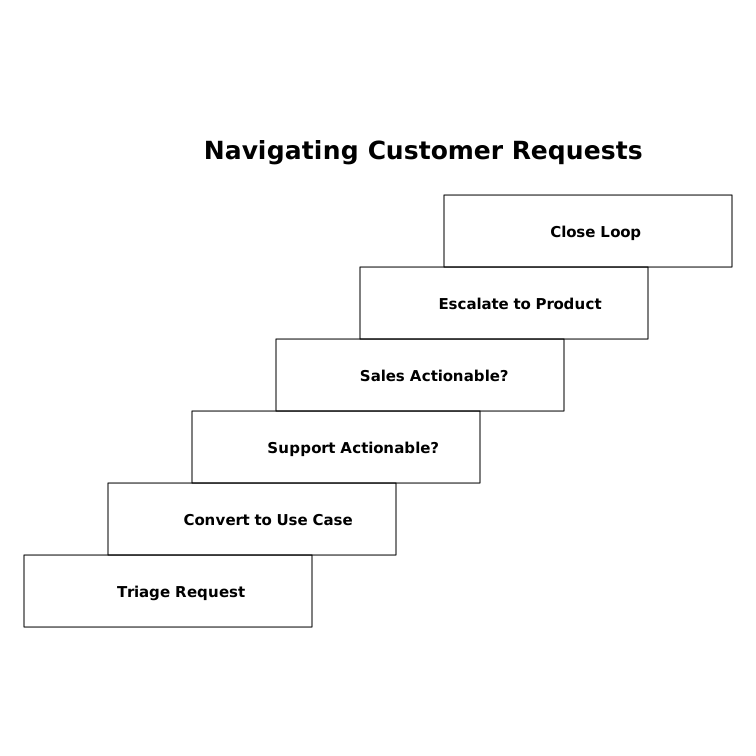
Think of the ladder as a progression from low-cost actions (support and information) to high-cost commitments (roadmap and delivery). Teams should climb only as far as needed to resolve the customer situation and capture the learning.
- Step 1: Triage and classify the request
- Step 2: Convert “request” into a concrete use case
- Step 3: Decide if it’s support-actionable now
- Step 4: Decide if it’s sales-actionable now
- Step 5: Escalate to product with quantified impact
- Step 6: Close the loop with a clear status and messaging
Step 1: Triage and classify the request
Start by separating feature requests from adjacent categories that masquerade as “a feature.” This prevents noisy inflow from consuming roadmap bandwidth.
- Bug: Something that should work but doesn’t.
- How-to / discoverability: The capability exists, but the user can’t find it.
- Integration / configuration gap: The request is really about setup or environment constraints.
- True net-new capability: The product does not currently support the job-to-be-done.
At this stage, standardize metadata. Minimum fields that keep future analysis possible: account name, segment (SMB/mid-market/enterprise), ARR or deal value at risk, affected role (admin, IC, exec), frequency (one-off vs repeated), and the workflow step where it blocks the user.
Tools matter because standardization breaks down quickly in spreadsheets and inboxes. A centralized system such as canny.io helps keep requests deduplicated, attributable to revenue, and trackable across customer conversations.
Step 2: Turn a request into a use case and acceptance criteria
Feature requests are often solution-shaped: “Add X,” “Support Y,” “Integrate with Z.” Before routing, translate the request into a problem statement:
- What are they trying to achieve?
- What happens today when they try?
- What outcome would “success” look like?
- What is the minimum acceptable solution?
A simple pattern that keeps responses consistent is context → constraint → consequence. Example: “In quarterly reporting (context), we can’t export by segment (constraint), so finance rebuilds the report manually and it delays close (consequence).”
If your organization deals with compliance-heavy workflows, the same discipline applies: you need traceability between what someone asks for and what it impacts. The mental model is similar to mapping evidence notes to controls in a traceability matrix, where you preserve structured links rather than unstructured comments. (See a practical traceability workflow for an analogous approach to structuring messy inputs.)
Step 3: Decide if support can resolve it now
Many “feature requests” are support opportunities. Before escalating, check for three fast paths:
- Existing capability: Provide steps, a short video, or a saved response.
- Workaround: Offer an alternative workflow that meets the acceptance criteria.
- Documentation or UI gap: File a doc update or small UX improvement instead of a major build.
Support actions should still feed the feedback system. The outcome is a richer request record: “Resolved by workaround,” “Resolved by education,” or “Blocked—needs product.” That history prevents repeat escalations and improves future deflection.
Step 4: Decide if sales should act on it
Feature requests often appear in late-stage deals or renewals as negotiation levers. The ladder helps sales avoid making accidental roadmap commitments while still moving the deal forward.
Common sales-actionable paths include:
- Packaging clarification: The capability exists in a higher tier, add-on, or requires an upgrade.
- Services/enablement: The customer needs implementation support, training, or best practices.
- Security/legal alignment: The “feature” is actually a procurement requirement (SSO, audit logs, data retention). Route it to the right owner with a timeline for assessment.
Sales should log two pieces of structure: what was promised (if anything) and what was explicitly not promised. This protects both the customer relationship and product credibility. If you maintain public roadmaps or statuses, align sales language to those statuses rather than ad hoc statements.
Step 5: Escalate to product with quantified impact
Only escalate to product when the request cannot be solved through support or commercial paths and the impact warrants a product decision. The escalation packet should be short but complete:
- Problem statement: One paragraph in the customer’s language.
- Who is impacted: Segment, roles, and number of accounts.
- Revenue context: ARR at risk, expansion potential, or deal value.
- Frequency: How often it appears across accounts and channels.
- Alternatives tried: What support/workarounds failed.
- Acceptance criteria: Minimum viable outcome, not a full design.
Product’s output should be one of a few clear statuses: investigate, planned, not planned, or needs more discovery. A feedback platform is useful here because it keeps demand linked to specific customers and revenue, making prioritization defensible rather than anecdotal.
Step 6: Close the loop without overcommitting
Closing the loop is where trust is built. It also reduces repeated tickets and “any updates?” pings. The key is to communicate progress in a way that’s accurate and consistent across support, sales, and product.
- If support resolved it: Document the solution and attach it to the original request record.
- If sales resolved it: Confirm what changed (plan, contract, implementation path) and update internal notes.
- If product planned it: Share the status and what problem you’re solving, not a hard ship date unless you truly have one.
- If not planned: State the reasoning (strategic fit, complexity, alternatives) and suggest a workable path.
Release notes and roadmap updates matter because they operationalize “close the loop” at scale. Customers don’t just want to be heard; they want predictability about what happens next.
How to operationalize the ladder in a weekly cadence
The ladder works best when it’s not an abstract framework. A simple operating rhythm keeps it alive:
- Daily: Triage new requests, dedupe, and capture missing metadata.
- Twice weekly: Support and sales review high-impact items and confirm which can be resolved without product.
- Weekly: Product reviews escalations with quantified impact and assigns statuses.
- Ongoing: Update statuses and notify customers when outcomes change.
Over time, the ladder becomes a shared language. Instead of debating individual requests in isolation, teams discuss the routing logic and the evidence behind the escalation. That’s what turns feature requests into consistent actions across support, sales, and product.
Vertical Video